
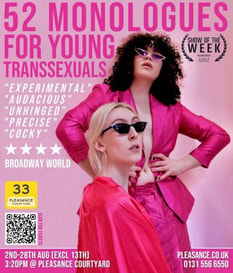
 52 Monologues for Young Transsexuals
Aug 18-28 - Pleasance Courtyard An expertly crafted examination of the complexities of identity and acceptance, this groundbreaking and unapologetic exploration of the trans experience is a triumph. The brilliance of the show lies in its ability to combine physical theatre with the power of collective stories in its exploration of the struggles, both internal and external, that many trans women face. These stories weave together a tapestry of experiences that touch on body image, love, acceptance, intimacy and self-discovery. At times the show is deeply confronting, but that is one of its greatest strengths and serves to highlight the show's commitment to authenticity. Our hosts, Charli and Laurie, are captivating, raw and unapologetic. Their unfiltered narratives supported by their seemingly unhinged dancing and a touch of baby oil, make for a truly mesmerizing show. Both women are adept at forcing the audience to face up to the very uncomfortable reality faced by trans people daily. However, the show is also peppered with moments of intense love and joy as Charli and Laurie shine a light on their own friendship. Against a backdrop of ever intensifying societal discourse on trans acceptance, this show stands as an important testament to the strength and resilience of trans people. - Aoife Burke 5/5 Book tickets here > https://tickets.edfringe.com/whats-on/52-monologues-for-young-transsexuals 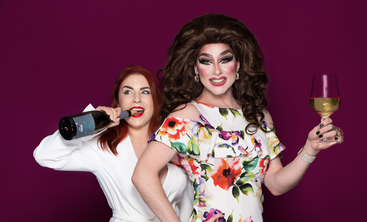 Drag Queen Wine Tasting
Aug 18-20, 23-27 - DoubleTree by Hilton Hotel Edinburgh City Centre Indulge in mouthwatering wine and delicious entertainment at the hands of the enigmatic Vanity Von Glow and wine virtuoso Beth Brickenden. This year’s Drag Queen Wine Tasting event is a carnival of entertainment that engages audience members and leaves them enlightened. A tantalizing tryst between quality wine, low-toned humor, and beautiful ballads sung by Vanity Von Glow, leads to a concoction that delights the senses. The chemistry between Von Glow and Brickenden is palpable, and their cheeky comic timing and interactions with audience members keeps viewers engaged. The constant interplay of their wit, sprinkled with saucy sexual innuendos, adds a layer of mischief that's not only entertaining but also infuses the show with a seductive charm. Our two powerhouse hosts work seamlessly together, blending their individual strengths to create an experience that simultaneously entertains and educates. Our outstanding sommelier, Beth Brickenden, guides the audience through the tasting of three delectable wines, her vast knowledge and expertise shining through. Beth's ability to seamlessly blend education and entertainment is a testament to her passion and expertise in the world of wine. Vanity Von Glow, on the other hand, injects the show with an ample dose of glamour and pizzazz. She infuses each moment with a touch of extravagance, and her interactions with the audience add a wonderfully fun dimension that makes everyone feel like part of the spectacle. Her beautiful singing voice entrances and engages, though she’s not above stopping mid song to draw attention to a handsome man passing by the window! The show is a beautiful blend of merriment and enlightenment, made possible by the union of two wonderful talents. Vanity Von Glow and Beth Brickenden prove themselves to be the ultimate hosts, navigating the journey through wine with flair, fun, and some mischief. So, raise your glass, join the chorus, and immerse yourself in this vivacious celebration of all things indulgent and delightful. - Aoife Burke Book your tickets > Drag Queen Wine Tasting | Cabaret and Variety | Edinburgh Festival Fringe (edfringe.com)  Karen
Aug 18-19, 21-26 - Greenside @ Riddles Court Get ready to witness a rollercoaster of emotions as our heroine navigates angst, office politics and the ultimate betrayal by her boyfriend Joe, all whilst trying to maintain her sanity. With each passing day, the tension between her and her arch-nemesis Karen reaches new heights. Join us on a hilarious journey as we watch our protagonist confront her deepest fears, explore the depths of female rage and prepare for the ultimate office showdown. In 2021 Sarah Cameron-West debuted a twenty-minute version of ‘Karen’ and would go on to win the Velvet Smoke monologue competition. Since then ‘Karen’ has evolved into a fifty-minute one-woman show at the Fringe and it is safe to say Cameron-West will be up for even more personal and critical success in this incredible showcase of writing and acting. Sarah Cameron-West plays the unnamed role of a thirty-something dealing with the fallout of her relationship ending at Alton Towers after four years together. As she processes the collapse of her relationship her ex Joe begins to date their shared co-worker Karen which sends her into a spiral as she seeks the advice of friends and family as she begins to rebuild her life. Cameron-West’s character at one point recommends and quotes ‘Succession’ from writer Jesse Armstrong to a colleague and for me, Cameron-West’s work and performance reminds me of another one of his shows, ‘Peep Show’. For many years there has been talk of a ‘Peep Show’ female-focused spin-off, remake with female comedians but nothing has ever come of it. Cameron-West’s work has echoes of what made ‘Peep Show’ so iconic and how she could be that next generation. ‘Karen’ has the elements of awkwardness, introspection, and the cringe-including misadventures that ‘Peep Show’ was known for, but she infuses it with a fresh female and modern perspective on the millennial experience. Cameron-West’s role showcases what an exciting talent she is due to her impeccable comedic timing, nuanced facial expressions, and ability to see the character's inner turmoil with such authenticity. Cameron-West has the right mixture of millennial awkwardness, social anxiety, and self-consciousness, making the character both relatable and hilariously cringe-worthy in scenes like the break-up that kicks the show off. The blend of internal and external monologues allows us to intimately connect with her struggles and anxieties. Cameron-West performs a mixture of external and internal monologues and uses the audience in the role of her friends, co-workers and family in such an effective way. This blend gives us a brilliant insight into our lead character and allows the audience to share in and hear her inner thoughts, fears and insecurities providing us with a powerful insight into her motivations, contradictions and anxieties. ‘Karen’ explores the societal expectations, body image, career challenges, and friendship dynamics that most millennials and women will relate to. The journey our lead experiences in just fifty minutes surrounds dating, workplace confrontations, managing parents' expectations and the intricacies of female friendships. The pain and humour we feel for our lead character are such relatable situations that often take awkward and unexpected turns. ‘Karen’ provides an opportunity for audiences to delve into the nuances of our lead characters' life in a way that will resonate with a modern audience. Sarah Cameron-West marks herself as one to watch with this perfect showcase for her talent and I can’t wait to see what she does next. - Lee Hutchison 5/5 Book your tickets here > https://tickets.edfringe.com/whats-on/karen  Steve Richards Presents: Rock'N'Roll Politics
Aug 18-26 - theSpace @ Symposium Hall In the last full year before the general election the legendary show returns with all the latest political dramas, characters, questions and unreliable predictions. Can Starmer win? Has Sunak a path to victory? Has the SNP peaked? Can Brexit ever be done? Let's try to make sense of it all and enjoy ourselves in the era of volcanic politics. There'll be a different show every day. In the spirit of UK politics, let me begin with a Declaration of Interests: I'm a weekly listener to Steve Richards' podcast, "Rock 'N' Roll Politics," I support him on Patreon, and I got him to sign my copy of his book (which I randomly picked up one day in a bookstore, leading me to discover him) "The Prime Ministers We Never Had: Success and Failure from Butler to Corbyn." With that out of the way - Steve Richards is a former political journalist and current commentator, serving previously as the political editor of the New Statesman, as well as writing for various publications and newspapers throughout the decades. His encyclopedic knowledge of UK politics (as well as his skill for various imitations of politicians from the past) provide an hour of entertaining, informative, and - during the audience questions/discussions - a chance to, in his words, "solve it all." His daily show at the Fringe covers various political themes each time - the Wednesday show examined Scottish Politics, particularly the SNP First Ministers Alex Salmond and Nicola Sturgeon, as well as the future of Humza Yousaf. Richards' reflections covered the first half, whilst the audience can ask any political question under the sun to prompt further discussion. Any question can instantly cause a tangent into a previous UK leader or story about a past election, providing a fascinating look into the past and the larger political "puzzle." This is a must show for any "political junkie" (such as myself) or anyone interested in the history, present, or future of the UK government. The seats in Symposium Hall are also the most comfortable in all of the Fringe! 5/5 Book your tickets here - https://tickets.edfringe.com/whats-on/steve-richards-presents-rock-n-roll-politicstickets.edfringe.com/whats-on/steve-richards-presents-rock-n-roll-politics Phillip Gilfus  Spring Awakening
Aug 17-19 - Greenside @ Riddles Court - Thistle Theatre The winner of eight Tony Awards, including Best Musical, told by Duncan Sheik and Steven Sater through what Entertainment Weekly called, 'the most gorgeous Broadway score this decade'. Spring Awakening explores the journey from adolescence to adulthood with a poignancy and passion that is illuminating and unforgettable. The landmark musical is an electrifying fusion of morality, sexuality and rock and roll that is exhilarating audiences across the nation like no other musical in years. From the company that bought RENT in 2016. This musical would seem a no-brainer to be performed at the Fringe. The cast from Dynamik Theatre Group show their dynamic talent in this "19th Century German play meets rock opera" musical. "Spring Awakening" is one of those shows that you've either seen before or merely heard whispered about in dark corners. Perhaps you have read headlines about "controversial play not allowed to be performed" in places around the world. There are warnings before you enter the venue, letting the audience know about scenes of a sexual violence, teenage suicide, and partial nudity. This "coming of age" tale certainly contains quite adult themes, but they are all contained in the original 1890s German play of the same name. This show is not just about "controversy" and the exploration of the darker themes of adolescence. The cast showcase their musical talent in a variety of songs that fill the black box theater with their emotion, from plaintive cries about the mysteries of life to the frustrations of adults standing in their way. The musical itself is quite quick, even at its 1 hour 50 minutes (with interval) run time. There is not much time to dwell on each characters' tragic discoveries about growing up in a constricted, controlled community; the songs are short and snappy (though well-performed) as we quickly move on to exploring the next struggle of these teenagers being denied knowledge about the wider world around them. If you haven't seen "Spring Awakening" yet, now is the perfect time to see what the "controversy" and mystery is all about. If you have seen it before, these performers, in all roles, provide the power and music to tell this story. The quick-paced nature of the musical can be frustrating, since further exploration of characters' stories, including some that appear in only a scene or two with what seems like a random injection of tragedy, would be interesting to develop. There is no doubt the audience will have plenty to talk about when they leave the show. 4/5 Book your tickets here - https://tickets.edfringe.com/whats-on/spring-awakening Phillip Gilfus |

|